Designing a home that supports your health
Environmental psychology research has identified specific design elements — light, colour, nature access, clutter — that measurably affect wellbeing and cognitive function.
Environmental Psychology
Environmental psychology is the study of how physical environments affect behaviour, cognition, and wellbeing. Its findings are counterintuitive in many cases: minor, often unnoticed features of physical space have measurable effects on mental state, performance, and health behaviours. Understanding these effects allows deliberate design of domestic environments for wellbeing outcomes.
Natural Light
Perhaps the most consistently documented environmental wellbeing variable. A study of 450 office workers found that those with more natural light exposure had 46 minutes more sleep per night and scored higher on all quality-of-life measures compared to those without windows. Residential research shows similar patterns: homes with more natural light access are associated with lower rates of depression, particularly in high-latitude, low-daylight months.
Design principles: orient desks and work areas toward windows; keep windows unobstructed by furniture and heavy curtains during daytime; use mirrors to amplify natural light in naturally dim spaces.
Clutter and Cognitive Load
Environmental clutter — visual disorganisation and excess objects without designated placement — maintains a low-level attentional burden. Each item in the visual field that requires action (dishes to wash, papers to file, clothes to put away) activates a mild "open loop" in working memory — the same mechanism that causes task completion anxiety.
A UCLA study of 32 middle-class families found that mothers in cluttered homes had elevated cortisol throughout the day, with the strongest correlation in the evening. Decluttering and establishing storage systems does not merely feel better — it measurably reduces physiological stress.
The minimum effective dose: a clear desk and clear surfaces in the primary relaxation spaces (living room, bedroom). Perfect organisational systems are not required; visual openness in the spaces where you rest and work provides the benefit.
Colour Psychology
Colour psychology evidence is more modest than often claimed, but some effects are consistent:
- Blue and green tones are associated with reduced heart rate, lower blood pressure, and reported calm in multiple studies — consistent with their association with natural environments
- Red increases physiological arousal and is associated with performance impairment on detail-oriented cognitive tasks
- Natural palettes (earth tones, neutrals) tend to produce the most neutral, stable affective environments — particularly useful in bedrooms
The strongest evidence is not for specific colours but for avoiding highly saturated, aggressive colour schemes in spaces intended for rest and focus.
Nature Biophilia
The biophilia hypothesis (E.O. Wilson) proposes that humans have an innate affinity for natural environments — evolved from millions of years in natural settings. Research supports this at a functional level: views of nature (even through windows or in images), natural materials, and living plants in interior environments reduce stress markers, accelerate recovery from stressful tasks, and improve mood and attention.
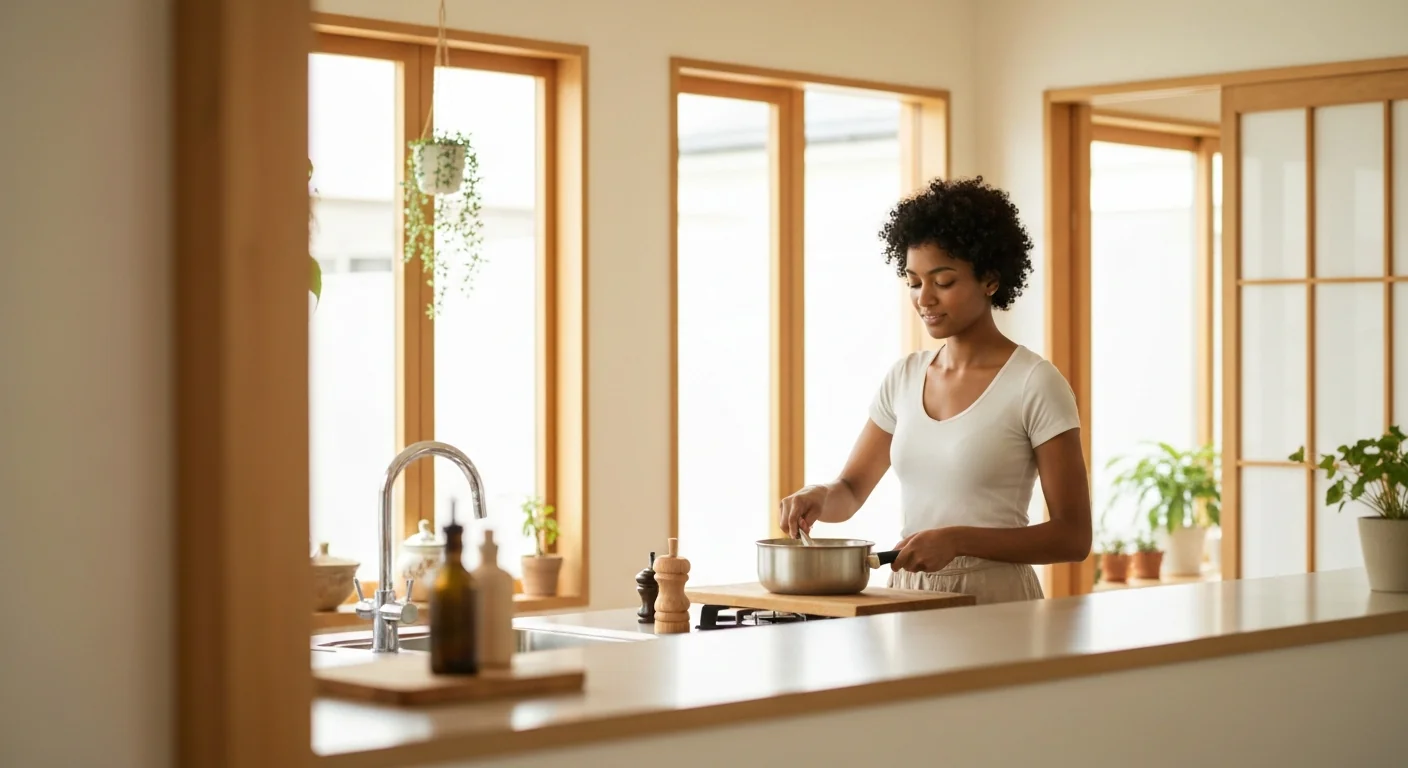
Even simulated nature (nature photographs, nature sounds) produces partial effects, though smaller than real nature exposure. The minimum design investment: one or more windows with outdoor views; a small number of healthy plants in regularly occupied spaces; use of natural materials (wood, stone, linen) over synthetic alternatives where affordable.
From the Good.You blog: The Daily Transitions That Most Affect Energy and Mood