Setting up your bedroom for better sleep
Your bedroom is either a performance tool or a performance limiter. The evidence on each variable is specific enough to give you an exact prescription.
Temperature: The Most Important Variable
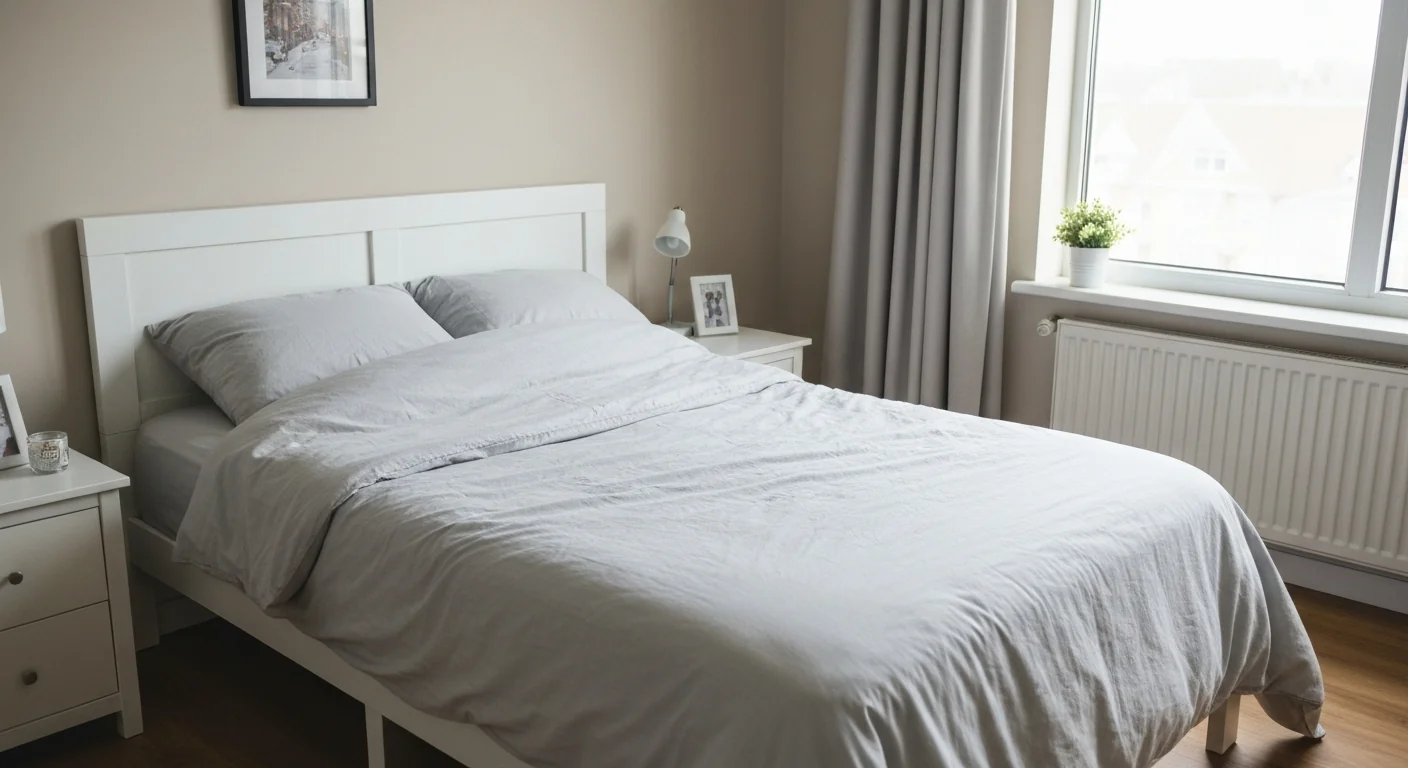
Sleep onset requires the body's core temperature to drop 1–3°F (0.5–1.5°C). This drop is supported by a corresponding drop in ambient temperature. Research consistently identifies a bedroom temperature of 65–68°F (18–20°C) as optimal for most adults, with a range of 60–71°F covering individual variation.
Higher room temperatures (above 75°F/24°C) significantly reduce deep sleep (N3) and increase night-time awakenings. This is why sleep quality often deteriorates in summer without air conditioning.
Cooling the extremities accelerates sleep onset by facilitating peripheral heat dissipation — warm feet and hands help core temperature drop faster. This explains why a warm bath 1–2 hours before bed actually improves sleep onset (the temporary skin warming draws blood to the periphery, accelerating core cooling).
Light: Complete Darkness Is the Standard
Even small amounts of light during sleep disrupt melatonin production and sleep architecture. A 2022 study (Mason et al.) found that even 100 lux of ambient light exposure during sleep — approximately the light level of a dim room, significantly less than typical artificial lighting — produced meaningful increases in insulin resistance and elevated heart rate compared to sleeping in darkness.
Practical standard: no light from streetlights, standby LEDs, or digital displays should be visible. Blackout curtains or a sleep mask are the primary interventions. Even the small LED indicator on a TV or charger is worth covering.
Sound: Masking vs Silence
Complete silence is not universally superior to managed sound. Irregular, unpredictable noises (traffic, neighbours, snoring partners) disrupt sleep by triggering the brain's threat-monitoring system — even during sleep. Continuous, predictable background sound — white noise, pink noise, or brown noise — can mask these disruptions by raising the acoustic floor, reducing the amplitude differential that triggers the arousal response.
Pink noise (lower frequency spectrum than white noise) has shown particular promise — a 2017 study in Frontiers in Human Neuroscience found that pink noise synchronised with slow-wave sleep oscillations significantly increased deep sleep and memory consolidation.
A fan achieves a similar masking function while also aiding temperature regulation.
Air Quality
CO₂ rises in enclosed, occupied bedrooms throughout the night. A 2017 Danish study found that CO₂ above 1,200 ppm (easily reached in a sealed bedroom with two people) was associated with reduced sleep quality and morning cognitive performance. Cracking a window or using a mechanical ventilation system maintains CO₂ below this threshold.
Low humidity (below 30%) causes dry mucous membranes and throat discomfort that can cause micro-awakenings. A bedroom humidifier can address this in dry climates or heated winter environments.