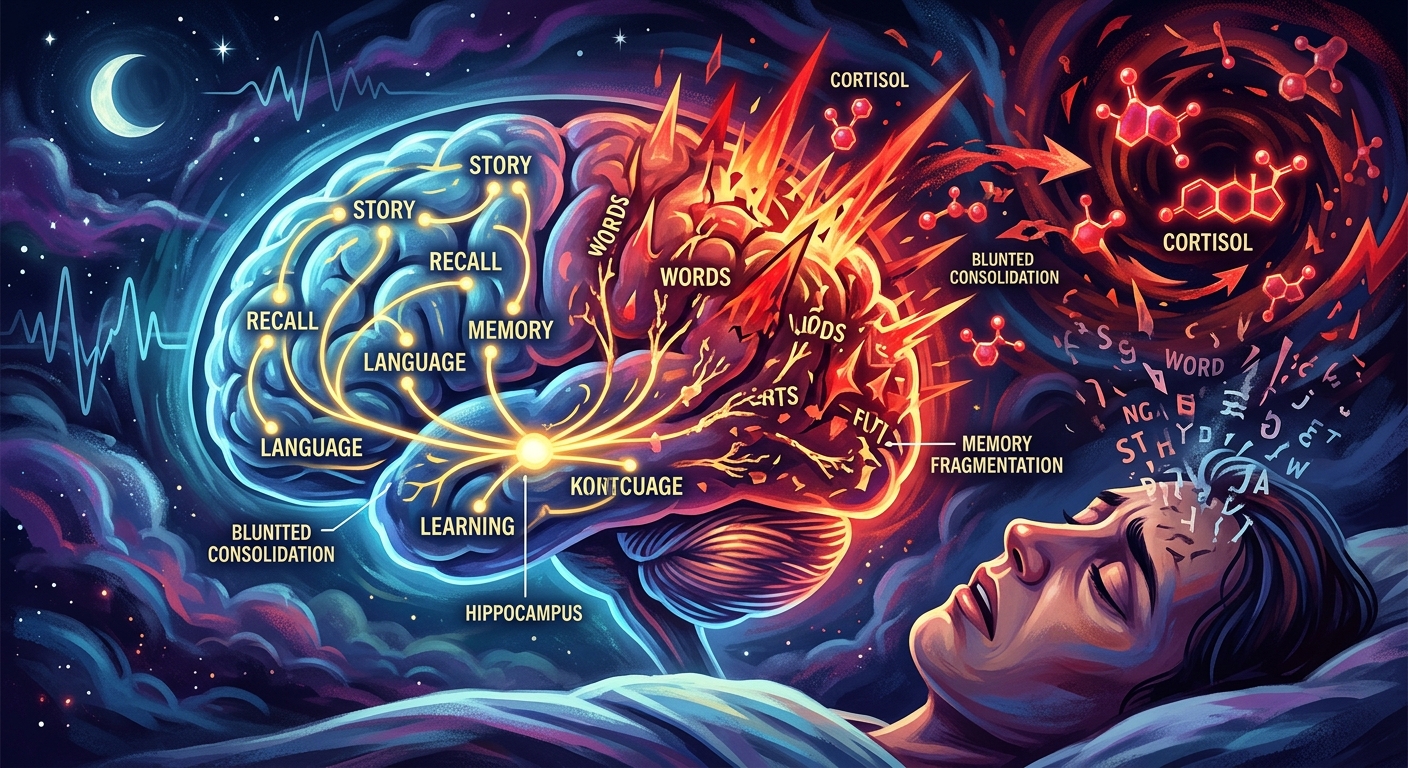
You sat in four hours of back-to-back meetings. You processed reports, absorbed briefings, debated strategy. By 9 p.m. your calendar was cleared. By morning, you could barely reconstruct what was said. This is not a focus problem. It is a chemistry problem, and it starts long before your head hits the pillow.
The Mechanism in 30 Seconds
- Chronic cortisol elevation suppresses NREM slow-wave activity, the sleep stage where verbal memories are replayed and encoded.
- The hippocampus holds verbal information in a temporary buffer and requires low cortisol to initiate the sharp-wave ripple sequences that transfer that data to long-term storage.
- An HPA-axis-grounded evening routine can measurably lower cortisol before sleep onset, restoring the overnight memory transfer that chronic stress disrupts.
The HPA Axis Does Not Clock Out at Bedtime
Cortisol follows a circadian rhythm. Under normal conditions, it peaks around 6 to 8 a.m., then gradually declines through the day, hitting a trough somewhere between midnight and 2 a.m. This trough is not incidental. It is biologically required.
In high-output professionals, this curve flattens. Deadline pressure, compacted cognitive load, constant digital interruption, and irregular sleep timing collectively keep the hypothalamic-pituitary-adrenal (HPA) axis running at a low but persistent simmer throughout the evening.
This is the distinction that matters: acute cortisol spikes are normal and adaptive. Chronic evening elevation is the problem. The two have different effects on the brain, and they require different interventions.
The hippocampus carries an unusually high density of glucocorticoid receptors. That makes it exquisitely sensitive to cortisol at doses that barely affect other brain regions. Small, sustained elevations that would register as unremarkable on a standard blood panel are enough to disrupt the cellular environment the hippocampus needs to do its overnight work.
Verbal Memory's Overnight Filing System
Not all memory is built the same. Verbal memory refers specifically to the encoding, retention, and retrieval of language-based information: words, names, spoken instructions, meeting content, reading material, and the substance of conversations.
During the day, the hippocampus holds incoming verbal data in a fragile, temporary form. The transfer of that data into stable long-term storage happens predominantly during sleep. More specifically, it happens during the slow-wave stages of non-rapid eye movement (NREM) sleep, when the neocortex and hippocampus coordinate in a process researchers call systems consolidation.
The following types of verbal information are most vulnerable to cortisol-related disruption during this window:
- Names of new contacts encountered during the day
- Key phrases, decisions, and agreements from spoken meetings
- Factual content absorbed through reading or listening
- Language-based instructions or procedural steps communicated verbally
- Emotional context attached to spoken exchanges
These are precisely the categories high-performing professionals rely on most. And they are the categories that chronic cortisol elevation targets first.
Sharp-Wave Ripples and the Cortisol Interference Problem
Here is where the biology gets specific. During deep NREM sleep, the hippocampus generates brief, high-frequency bursts of electrical activity called sharp-wave ripples. These ripples are the replay mechanism. They reactivate the neural patterns from the day's learning events in coordination with slower cortical oscillations called sleep spindles and slow waves.
This is not a metaphor. The hippocampus is literally replaying the verbally-coded information from your day, pattern by pattern, consolidating each one into more durable cortical storage.
Cortisol interferes at several distinct levels:
- It suppresses NREM slow-wave amplitude, reducing the strength of the oscillations required for hippocampal-cortical dialogue
- It activates glucocorticoid receptors in hippocampal CA1 and CA3 regions, reducing the synaptic plasticity that underlies replay-based encoding
- It fragments sleep architecture, compressing restorative slow-wave sleep into shorter, less effective windows
- It elevates arousal threshold instability, increasing the probability of micro-awakenings that interrupt replay sequences mid-stream
Acute Cortisol Spikes vs. Chronic Evening Elevation: Memory and Sleep Outcomes
| Factor | Acute Cortisol Spike | Chronic Evening Elevation |
|---|---|---|
| Duration of cortisol rise | Minutes to 1-2 hours | Hours; persists into sleep onset |
| Effect on verbal memory | Can enhance encoding at the moment of the stressor | Impairs overnight consolidation of the day's learning |
| Slow-wave sleep impact | Minimal if cortisol returns to baseline before sleep | Reduces slow-wave amplitude and duration significantly |
| Hippocampal sharp-wave ripples | Largely unaffected | Frequency and coherence reduced during early NREM |
| Recovery timeline | Single night of good sleep typically sufficient | Requires consistent HPA regulation over days to weeks |
| Primary intervention point | In-the-moment stress response tools | Structured evening wind-down targeting HPA axis descent |
Establish Your Baseline Before You Try to Fix Anything
Reading about memory impairment and experiencing it are two different things. The most actionable first step is to measure where you actually stand, before making any changes to your routine.
A verbal memory test gives you a concrete, repeatable score to work from. Run it today. Record your result. Run it again after two weeks of the protocol below and compare. Without a baseline, behavioral change stays abstract. With one, it becomes a data set with before and after values attached.
Most people who do this are surprised. The gap between perceived verbal recall and measured performance tends to be larger than expected, particularly in people logging fewer than six and a half hours of sleep while under sustained occupational stress.
What Glucocorticoid Research Confirms About Hippocampal Replay
The evidence base here is consistent and well-established. Studies using intravenous hydrocortisone infusions administered during early nocturnal sleep have demonstrated measurable reductions in declarative memory retention the following morning, with effect sizes large enough to register on standard recall tests. The critical variable is not the total dose but the timing, specifically whether elevated cortisol coincides with the early NREM slow-wave window.
A search through indexed glucocorticoid and memory literature returns a consistent finding: glucocorticoid receptor binding in the hippocampus during sleep suppresses the LTP (long-term potentiation) needed for replay-based encoding, and this effect is observed at cortisol levels that fall within the high-normal range on routine laboratory panels, not just in clinical hypercortisolism.
This matters because it shifts the clinical threshold. You do not need a cortisol disorder diagnosis for this mechanism to be active in your brain tonight. Persistent occupational stress, compounded over months, is sufficient to sustain the evening elevation that blunts replay.
The HPA-Axis Evening Protocol That Changes the Overnight Pattern
The goal of this protocol is not relaxation in the general wellness sense. The goal is physiological: reduce free cortisol below the threshold that suppresses sharp-wave ripple activity before sleep onset. Every step maps to a known mechanism in the HPA axis suppression pathway.
- Hard cognitive cutoff at 8:00 p.m. Active task demands sustain prefrontal-cortical arousal and prolong HPA output. A fixed, non-negotiable end time for work inputs begins the cortisol descent curve earlier each night.
- Moderate carbohydrate intake with dinner, not elimination. Insulin and cortisol operate in reciprocal signaling. A carbohydrate-containing meal 2 to 3 hours before bed supports the downward cortisol slope without disrupting sleep architecture, contrary to advice that lumps all evening carbohydrates together as problematic.
- Thermal drop stimulus 60 to 90 minutes before bed. Core body temperature and cortisol both need to fall for sleep initiation. A warm shower or bath triggers peripheral vasodilation, accelerating the temperature decline that signals to the suprachiasmatic nucleus that sleep timing is appropriate.
- Low-light environment from 9:00 p.m. onward. Blue-spectrum light suppresses melatonin and indirectly sustains cortisol by shifting the circadian phase. Amber or dim warm lighting is not aesthetic preference. It is a direct circadian signal to the HPA axis that the day is ending.
- Extended-exhalation breathing: 4 to 6 cycles. Parasympathetic activation via vagal efferents directly counteracts HPA axis output. Slow exhalation at twice the length of inhalation reliably reduces heart rate variability markers of cortisol stress within 10 minutes in controlled protocols.
- Fixed sleep onset window every night. Circadian regularity predicts the amplitude of the overnight cortisol nadir. Irregular sleep timing blunts the trough, leaving baseline cortisol higher during the exact early-NREM window when verbal memory replay is most active.
Why Eight Hours Is Not Enough When Cortisol Is Still High
Duration of sleep does not guarantee functional memory consolidation. If cortisol remains elevated during the first third of the night, when slow-wave sleep density is highest, the replay window is compromised regardless of total hours logged on a sleep tracker.
This explains a pattern many high performers recognize without being able to name it. They sleep a full night and still forget names by midday. They cannot reconstruct conversations from the day before. They feel like they absorbed information during the afternoon and lost it by morning. The clock says they slept. The hippocampus did not complete the filing job.
The protocol above addresses the biological substrate directly: cortisol timing during the consolidation window, not sleep duration as a standalone metric.
From Mechanism to Measurable Signal: Closing the Loop
The pathway from stress to forgotten conversations is traceable at every step. Chronic occupational pressure sustains evening cortisol. Elevated cortisol at sleep onset suppresses slow-wave amplitude and disrupts hippocampal sharp-wave ripple sequences. Those ripples are the biological machinery for encoding what you said, heard, and read during the day. Without them running cleanly, verbal information that felt absorbed at 5 p.m. is largely inaccessible by 7 a.m.
The protocol ties directly to those links. The breathing intervention targets HPA suppression via vagal activation. The carbohydrate timing targets insulin-mediated cortisol reduction. The light management targets melatonin restoration and circadian cortisol phase. The fixed sleep window targets nadir depth.
Each step is answering a specific question the HPA axis is asking: is this a time to stay alert, or is the day finished? The evening routine's job is to give the axis a clear, consistent, physiologically grounded answer. When it gets one, the hippocampus gets the quiet it needs to do the work your waking hours depend on.
Start with the baseline score. Apply the protocol for two weeks. Run the test again. Let the data tell you what your hippocampus is doing with the night you are giving it.